

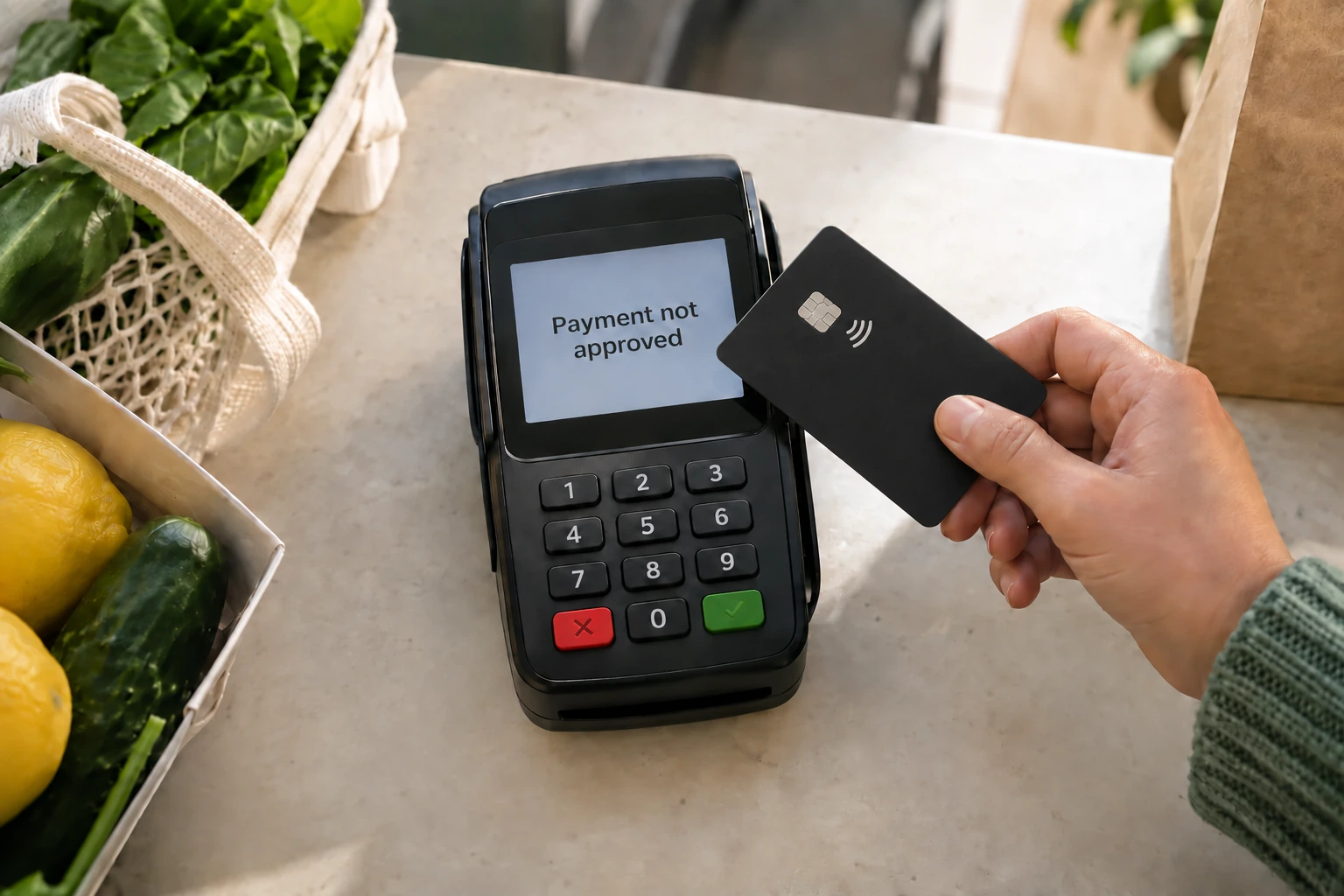
Usually, the money you can see isn't the money your card can use right now. Hotels, fuel pumps and car rental desks put holds on part of your balance. Spending limits cap what goes out in a day. In Europe, your bank may just want you to confirm it's you. Less often, the purchase type is blocked, and no amount of money gets it through.
"But I have money": holds
A hotel, fuel pump or rental desk doesn't know your final bill yet, so it asks your bank to set aside an estimate. That money stays in your account but no longer counts towards what you can spend. Your app's headline balance may still show the full amount.
Say you check into a hotel for three nights at $180 plus 15% tax. The hotel holds the room ($621) plus $50 a night for incidentals ($150): $771 in total. With $900 on the card, you have $129 left to spend. That evening's $140 dinner is declined, though your app still says $900.
How a hotel hold leaves $900 unable to pay for a $140 dinner
Three nights at $180 plus 15% tax, with $50 a night for incidentals, on a card with $900 on it.
The holds that catch people out most:
- Hotels hold the room, tax and incidentals for every night. Each hotel sets its own incidentals amount, so ask at booking or check-in. Marriott's terms warn that a hold can stay on your account for up to five business days after you leave. For a longer stay, check in with a credit card or a card with plenty of room. A hold on a debit card ties up your own money until it drops.
- Fuel pumps check your card before you fill up. In the US that check is a $175 hold, and newer pumps can hold up to $500. In Europe, card network rules let pumps hold up to €350. With $140 on a debit card, the $175 check can fail even if you want only $50 of fuel. Pay inside at the kiosk instead: you authorise the exact amount.
- Car rentals hold the estimated rental plus a deposit. At Los Angeles airport, Hertz's terms list $200 to $900 on top, depending on the car, and up to $500 on top for debit cards. In the US, Enterprise charges a debit card the full rental and deposit up front. It refunds the deposit 5 to 10 business days after you return the car, and refuses virtual cards and online-only card numbers.
A hold can also count twice. If the hotel runs a fresh charge at checkout instead of finalising the hold, both can sit on your account at once. In the example above, a $655 final bill (the room plus $34 from the minibar) and the $771 hold tie up $1,426 against your $900. A card network's merchant guide calls this money "held in duplicate". Until the hold is released, which can take days, the card declines almost everything.
How long until a hold comes back
Since April 2024, card network rules give merchants a fixed window between approval and the final charge. Once the merchant completes or cancels, it must release the unused amount within 24 hours.
How long a merchant can keep your money on hold
The longest a merchant can wait between approval and the final charge under card network rules, with a typical hold size. Once the final charge goes through, the merchant has 24 hours to release the rest.
| Merchant type | Typical hold | Longest wait before the final charge |
|---|---|---|
| Pay at the pump | US $175 check, up to $500; Europe up to €350 | 2 hours |
| Shops, restaurants | The bill (a tip can be added afterwards) | 5 days |
| Subscriptions, instalments | The charge | 5 days |
| Online purchases | The order total | 10 days (30 with extended authorisation) |
| Bike, scooter, equipment rental | An estimate | 10 days |
| Hotels, car rental, cruises | Room + incidentals; cars $200–$900 on top | 30 days |
If a hold is still there after the stay, the fastest fix is to ask the merchant to release it (a "reversal" of the authorisation). A refund is different: it's for money actually charged. Keep your folio or receipt. The UK's payment rules go further. When the amount wasn't known in advance, your bank may block funds only if you agreed to the exact amount. It must release them without undue delay once the final amount is known.
Limits you don't see on the balance screen
Your card has limits on top of your balance: per purchase, per day, sometimes per month, and separate ones for cash. Go over one, or use the card too many times in a day, and it's declined whatever your balance. Many apps let you view or change these limits.
Contactless has its own counters. In the EU, a tap without a PIN is capped at €50. After €150 in total, or five taps in a row (your bank picks which counter), the next tap asks for your PIN or an approval on your phone. Five small coffees and a sandwich can trigger it. If a tap is declined, insert the card and enter your PIN.
The UK scrapped its fixed £100 and £300 contactless limits on 19 March 2026 and lets banks set their own, but most kept the old ones. Elsewhere the no-PIN ceiling varies: CHF 80 in Switzerland, CAD 250 in Canada, AUD 200 in Australia. Apple Pay and Google Pay use the same card, with the same holds, limits and checks.
Why it works in shops but not online
Online payments have their own checks, none of them about money:
- Verification (3-D Secure). In the EU, an online payment over €30 usually needs you to confirm it's you. Smaller ones skip the check until, since you last confirmed, they add up to more than €100 or number five in a row. If the approval screen doesn't load, times out or opens the wrong app, the shop just says "declined". Open your banking app before you press Pay, approve, and retry once.
- Address check. In the US, UK and Canada, many shops compare your billing postcode with the bank's records. A typo, an old address or a stray space can cause a decline.
- Security code and expiry. A wrong security code, or the expiry date of an old card, is declined straight away.
- Replaced card. A new card often has a new number. Subscriptions keep trying the old one and fail once it stops working, unless the merchant and your bank both use the card network's account updater service.
When the purchase type is blocked
Every card payment carries a merchant category code that tells the bank what kind of business it is. Card programs block some categories outright, usually gambling, buying crypto or foreign currency, money transfers and loading prepaid cards. The bank answers "not permitted", and card network rules forbid the merchant from retrying. More money on the card changes nothing.
Tara's card terms, for example, let the card decline cryptocurrency purchases, betting, person-to-person transfers and account top-ups even when you have money. Cash advances aren't offered.
Fraud checks, travel and outages
Banks score every payment for fraud risk. A purchase that doesn't fit your usual pattern (a new country, a large amount, a string of quick purchases) can be declined. The fix is usually a confirmation in your app or a quick call, then one retry.
Some issuers, American Express among them, now say travel notices may be unnecessary. Regional blocks still apply: some cards can't be used in certain countries, and payments involving sanctioned countries are refused by law. If the bank or the card network is down, wait a few minutes or use another card.
"It said declined, but the money has gone"
Usually the approval arrived after the terminal gave up. Outside Europe, card network rules make terminals wait at least 15 seconds and send a reversal if the approval comes back late. Until that reversal lands, the amount sits in your account as a hold. Pulling the card out too early does the same. In one case on the Monzo forum, the money came back within five hours; the bank had quoted eight days.
If the terminal said declined but your balance dropped, ask the shop to check its terminal record before you pay again. Pay once more at most (another card is safer), and let the held amount drop.
Offline terminals on planes, trains and some buses work the other way round. They let the sale through without asking your bank, then ask for approval later. That's usually within 24 hours, up to four days on buses and trains, and within 24 hours of landing on a plane. If the money isn't there by then, the payment is declined after you've left.
Should you try again?
Once, after you've fixed something: approved the payment in your app, switched to chip and PIN, corrected the postcode, or waited for a hold to drop.
The terminal usually shows only "declined". Banks keep the real reason for you, so fraudsters learn nothing from it. Your banking app or a call to your bank tells you.
Card decline codes in plain English
Type a code or a word from your receipt, screen or message.
| Code | What it means | Try again? | What to do |
|---|---|---|---|
| 05 | Do not honour: the bank said no without a reason | Once, after checking | Look for a security prompt in your app; if none, call the bank |
| 51 | Not sufficient funds: what's available is too low, holds included | After fixing | Compare available with your balance; wait for a hold to drop or pay less |
| 61 | Over a spending limit (per purchase or per day) | After fixing | Raise the limit in your app or wait for it to reset |
| 65 | Depends on the card network: too many uses in the period or, in the EU and UK, approve the payment first | After fixing | Too many uses: wait or call. Approval needed: insert and use your PIN, or approve in the app |
| 1A | Extra verification needed (EU and UK) | Once, after approving | Approve in your banking app, then retry |
| 70 | PIN needed (EU and UK) | Once, with PIN | Insert the card and enter the PIN |
| 55 / 75 | Wrong PIN / too many wrong PINs | 55: yes. 75: after reset | Re-enter carefully; reset the PIN through your bank if locked |
| 54 | Expired card, or the expiry date is missing or wrong | After fixing | Use the new card or correct the date |
| N7 / 82 | Security code (CVV) check failed | After fixing | Re-enter the three digits; in a shop, insert the chip |
| 6P | Your details don't match the bank's records | After fixing | Check the name and billing address |
| 14 | Card number doesn't exist | Never as it is | Retype the number |
| 57 | Not permitted for this card: the purchase type is blocked (for example gambling, crypto purchases, money transfers) | Never | Pay another way |
| 62 | Card restricted in this country or region | After fixing | Check your card's region settings or call |
| 5C / 9G | Blocked by the bank / blocked by you (card controls) | After fixing | Check whether the card is frozen or online or abroad use is switched off |
| 59 | Suspected fraud | Once, after confirming | Confirm the purchase in your app or by phone |
| 78 | New card not activated, or a temporary block | After fixing | Activate the card or call |
| 83 | Card network fraud or security decline (new from 25 July 2026) | After calling | Contact your bank |
| 93 | Blocked by law (for example sanctions or unlicensed gambling) | Not by retrying | Not fixable by retrying |
| 91 / 96 | The bank or network is down | Later | Wait a few minutes or use another card |
| 41 / 43 / 46 / 04 / 07 | Card reported lost or stolen, account closed, or pick-up card | Never | Use another card and call the bank |
| Z5 | The account is valid but can't take this amount | After fixing | Try a smaller amount or another method |
No match. Most declines come back as the generic 05; your bank can tell you the exact reason for any attempt.
Card network rules split declines into two kinds. A merchant must never retry some, such as "not permitted" or a card reported lost. Others it may retry up to 20 times in 30 days. Networks charge merchants for excessive retries. Fraud systems read a burst of attempts as someone testing a stolen card, which can get the card blocked.
If you call your bank, have the merchant name, time, amount and currency ready, so they can find the attempt.
How this works in Tara
Tara is a money app for people who keep their savings in digital dollars. You hold USDC and USDT in a wallet only you control (the Vault), and spend with the Tara card from a separate spending balance (the Smart Account).
That split explains the crypto-card version of "but I have money": the money is there, just not in the balance the card spends from.
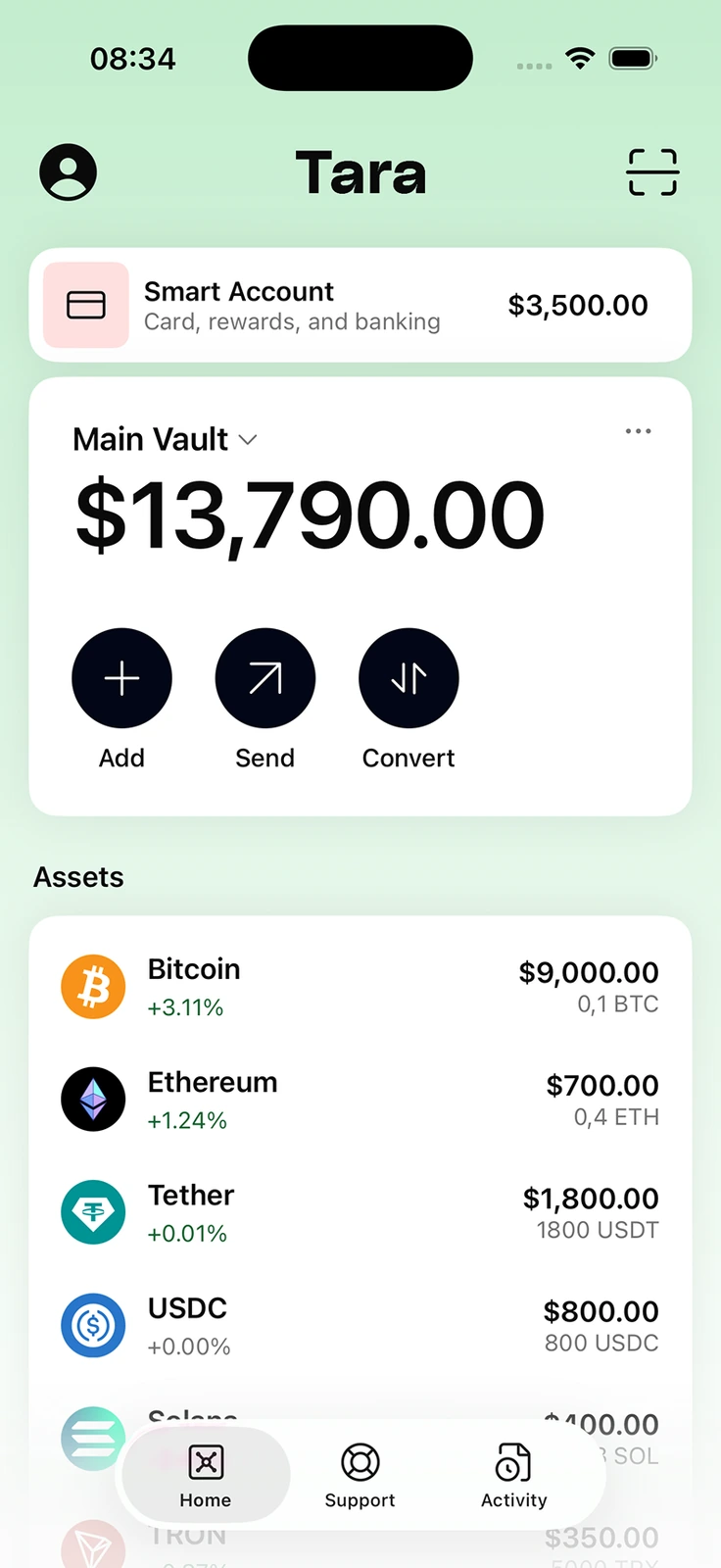
Hold your digital dollars
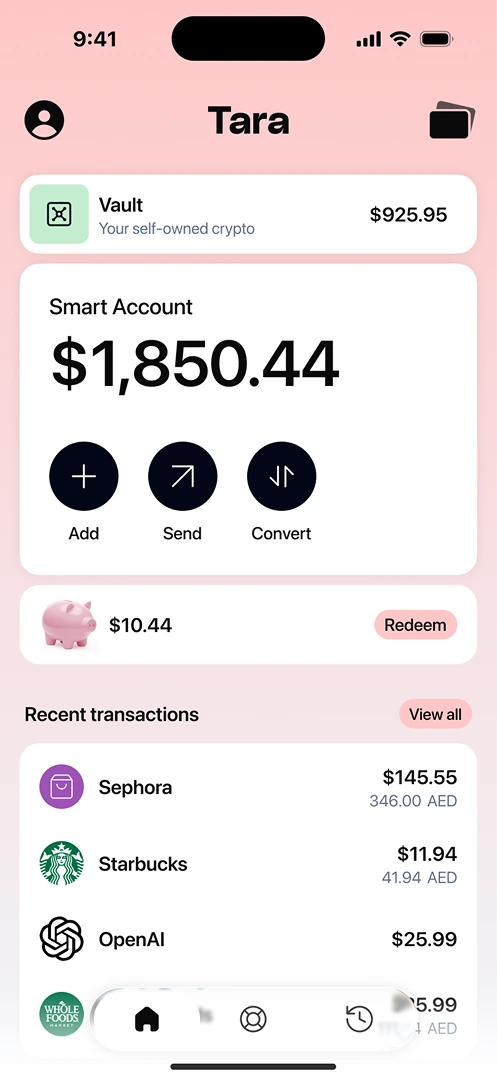
Your spending balance
Where the card's money comes from in Tara
An example with 1,200 USDC held and $300 moved for spending.
- Vault 1,200 USDC Only you control it. The card doesn't spend from it.
- You move $300 You choose the amount. The rest stays in the Vault.
-
Smart Account: your spending balance
$300
Car rental hold $180$120 left to spend
- Tara card Dinner $95: approved, $25 left Pharmacy $60: move $40 more, approved, $5 left
In practice:
- You decide how much is spending money. The card uses only what you put in your spending balance. The rest stays in your Vault.
- Money you receive lands in your Vault. On Ethereum-compatible networks, Solana, Tron and Bitcoin, Tara detects an incoming transfer, tracks its confirmation and notifies you. Move what you want to spend to your spending balance. The card spends dollars, BTC, ETH or SOL, and you choose which one it uses first.
- Holds work as on any card. They reduce what you can spend until the merchant sends the final amount.
- Refunds come back ready to spend. A completed card refund lands in your spending balance and pays first for your next card purchases.
- Freeze the card from the app. Lost your card? Freeze it, and payments pause until you unfreeze it.

Hold everything. Spend anywhere.
Your crypto and everyday payments, together in one app.
Join the waitlistSources
- Card network core rules and product rules, 18 April 2026 edition (authorisation windows, pump limits, decline categories, terminal time-outs)
- Card network business news: new authorisation time frames: the April 2024 authorisation windows
- Card network merchant guide: estimated authorisation and reversal requirements (24-hour release, funds held in duplicate)
- EU Regulation 2018/389, Article 11 and Article 16: contactless and online limits
- FCA: contactless limits, December 2025
- UK Payment Services Regulations 2017, regulation 78
- Georgia Consumer Protection Division: debit card holds
- Marriott check-in terms, Hertz rental terms, Enterprise forms of payment
- American Express: reasons for a credit card decline
- Stripe: card declines and card verification checks; Adyen: do not honour
- Monzo Community: payment declined but money gone, January 2026
- Tara card terms, checked 30 September 2026
- Hold = room $621 ($180 × 1.15 × 3 nights) + incidentals $150 ($50 × 3). Illustrative rates; the structure (room, tax and a per-night amount for incidentals over the whole stay) follows Marriott's published check-in terms.card network merchant guide notes the money can be held twice for a while: $771 + $655 = $1,426 against the same $900.
- Sources: card network core rules, 18 April 2026 edition (windows in force since 13 April 2024); Hertz and Enterprise US rental terms. Online orders flagged for extended authorisation also get 30 days. The second large network's windows could not be checked against its own rulebook.
- Meanings and retry rules from the card network core rules (18 April 2026, Table 7-2). "Never" codes are ones the network forbids merchants from retrying; for the rest, merchants may retry up to 20 times in 30 days, but more than one or two attempts rarely helps you.
- UX Design Awards: Tara's Concept award and the jury statement, Autumn 2026


